• We are STAs
    • Asha Rountree
    • Haley Ma
    • Kate Shih
    • Kyra Lee
    • Nicholas Peasley
    • Sasha Kenney
    • Shanda Horm
    • Shriya Atreya
    • Tomas Marulanda-Mesa
  • We were STAs
  • STA Presentation
    • STA Presentation 2017
    • STA Presentation 2016
  • Testimonials
  • Resources
  • Home

STA Blog

E-Lucy

September 15, 2016 By Valerie Lopez

Request: Our department was approached by Professor Kappelman on creating a supplementary graphic to his discovery in the death of one of our earliest ancestor, Lucy. The graphic initially was meant to be an image portraying the fall of Lucy however throughout the weeks, the request changed from 1 image to 3 to 5 and then finally 6 depicting the different stages of Lucy’s fall. The change in request came from the realization that one image would not be enough to accurately present the fatal impacts to Lucy’s body since they occurred one after another at her point of impact. Each image was meant to show a fatal blow.

Project Manager: Suloni Robertson

The Process 

I. Research

elucy-comp-all
Photo taken from elucy site

Lucy, A Pliocene fossil is one of the oldest and most complete fossil hominin skeletons discovered. She is an important source of information regarding bipedal evolution. Her anatomy has characteristics similar to both human and a chimpanzee. Her bones show that she was a biped meaning she walked on her feet.  Her knees were close together causing her legs to be at an angle which resembles humans. Her skull was similar to a chimp in that it was elongated with a small brain case (see video below) with the face and jaw coming out of the brain case. Her shoulder blades suggest that was suited for climbing trees and also had long arms with curved fingers.  However, Lucy also had a spine connection supporting her head and a broad pelvis like a human. Her arched feel also supported the idea that she walked like a human. All of these were facts I gathered from the video I found on youtube by the California Academy of Sciences. I went through many sites looking for more information about Lucy’s anatomy to ensure that I was able to draw it accurately.

Some references I looked through at the time:

1.) Elucy website

2.) Video comparing the anatomy

3 & 4.) Video regarding information about Lucy’s fossil

https://www.youtube.com/watch?v=PR_9_5gxvxg

II) References

I also consulted with Professor Kappelman many times about the proportions of her limbs in relation to her body and about how her body must have been positioned at the time of the fall. Professor Kappelman sent me many photos of a reconstructed Lucy to get a better ida of how she may have looked, as well as images of chimps for getting a better idea of their limb proportions, and also sent me photos of people falling from different heights and how they may have tried to position their arms to stop the fall.

screen-shot-2016-09-13-at-8-34-51-pm

screen-shot-2016-09-13-at-8-23-57-pm

III) Rough Sketches, more references, models:

This project was something very difficult to do. Lucy, has anatomy that is different, and my job was to draw out her impacts based on how her anatomy was. Professor Kappelman and I had to pose many times in the lab to establish how she may have been positioned at different impacts. However, Professor Kappelman’s frame was too tall and long for it to be an accurate representation, and while I am short at 5ft, my limbs are still different from hers and still wasn’t very accurate. However the posing helped me  to get an idea of how to approach drawing her fall.

Rough sketches at the beginning of the project. At the time  I was only meant to draw 1 image rather than the  6 that was decided on in the end.  The first was my first rough, the second and third were fixing the position of the limbs and trying to get the anatomy correct.

At this point, we had already taken pictures with Professor Kappelman and I as models for references in the positioning of Lucy’s body. The image count went up to 3 by this point highlighting the most fatal blows. Here it was to show the impact of her landing feet first and causing the break on her knee. I drew roughs over my body in the pose. However, this isn’t very accurate since we can’t actually record myself falling and my leg limbs were to long to accurately show the position of the leg during impact. screen-shot-2016-09-13-at-8-47-03-pm

After consulting with Professor Kappelman, the positions began to shift as he started to connect more the injuries together. With an art model he tried to show me a more accurate view of how she may have fallen.


More models were made along with more research and more meetings with Professor Kappelman. Suloni (Project Manager) suggested I made wire frame models so that when I met with professor Kappelman, he would be able to show what positions of Lucy he wanted me to draw.

The most difficult part of this was trying to decide which perspective to show her fall from. Lucy suffered injuries to both sides of her body when her body twisted under while making impact to the ground.

screen-shot-2016-09-13-at-8-56-21-pm

At this point, I tried to get Lucy’s form but there were somethings that came out a bit strange and still needed to be fixed. A problem we had with the chosen perspective was twisting Lucy’s “standing form” enough that her leg covered her private areas while still showing enough of both legs and arms. There is apparently an unspoken rule about showing female genitalia in scientific journals. Finally after so many draft and iterations, I had a rough of what was now 5 drawings since at the time Professor Kappelman was able to make new connections to certain injuries and wanted to show them as well.

screen-shot-2016-09-15-at-12-31-56-pm

From there, it was a matter of fixing the details. Each time I would draw a draft and Professor Kappelman would let me know what needed to be change. Lucy needed to be less muscular, her arm needs to be moved a bit, rotate the head, fix the length of the torso. After each draft, we were able to finish an image that we were satisfied could depict Lucy’s fall.

Example of a draft and the kind of feedback I would receive from Professor Kappelman

Lastly after submitting my Lucy illustration, Professor Kappelman took the illustrations of each pose, added images of the breaks to her bones, and made the animation that was featured on Nature Journal and many news outlets.

nature19332-f2


Nature: International Weekly Journal of Science

https://sta.laits.utexas.edu/wp-content/uploads/2016/09/nature19332-sv4.mp4

Overall, this was one of my biggest projects as an STA. I had the opportunity to work on a scientific discovery with a notable Professor as my client and had my illustrations published on a renowned scientific journal as well as on many credible news sites. It was difficult for many reasons. At the time, it was essential to keep the discovery of Lucy’s death a secret and so there was a rush to get all the materials ,that was to be published, completed as soon as possible to ensure that the secret stays a secret until its final released. I had to do a lot of research of the anatomy of both chimps and humans and specifically Lucy. I had to get the position and placement of her limbs accurate which meant making different kinds of models, even modeled myself, to get the placement just right. Overall, it was essential that I kept communicating with both Suloni and Professor Kappelman to make sure that everything looked satisfactory. It was a lot of work but it was more than worth it after being able to see my work published. This is definitely one of the examples of where being an STA has given me amazing opportunities.

Filed Under: 2016 - 2017, Uncategorized

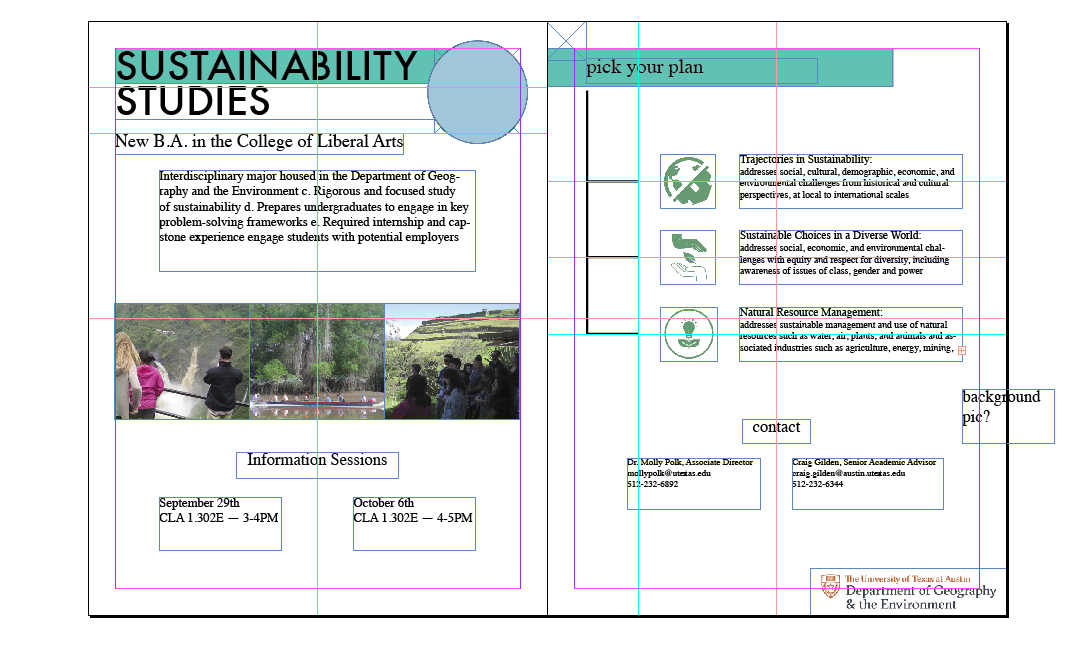
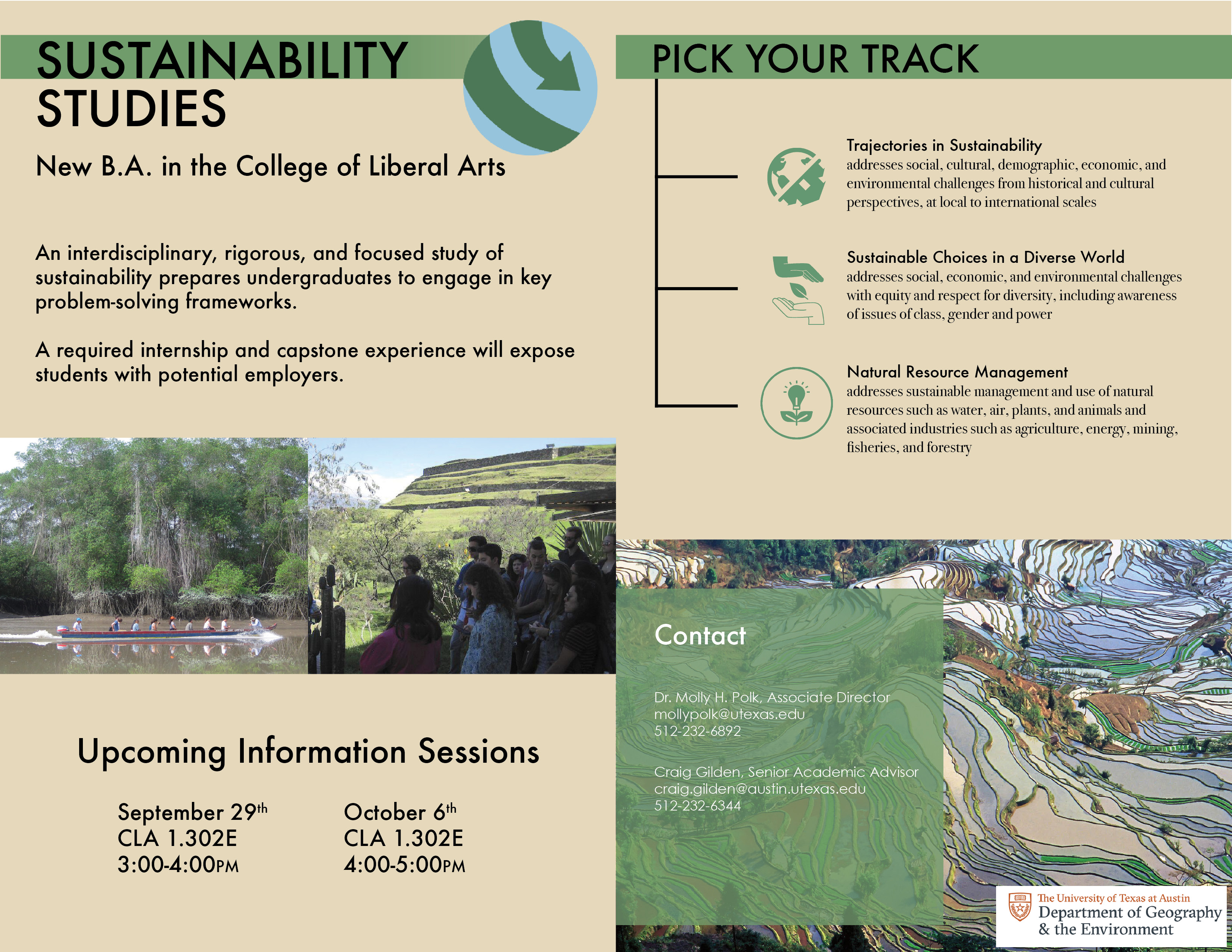
BA Sustainability Studies Flyer

September 12, 2016 By Roopa Nagarajan

bass-screen

bass-screen-mockup-2

First two rough mockups of the BA Sustainability Studies video monitor graphic with focus on general layout.


bass-mockup-3

A third mockup with client feedback.


bass-mockup-4 bass-mockup-5-boat

Two options for the video screen ad. The trees are fading outwards, the globe’s mockup is cleaner, and “Information Sessions” carries more weight.


screen-shot-2016-09-12-at-5-20-28-pm

screen-shot-2016-09-12-at-5-24-53-pmscreen-shot-2016-09-12-at-5-24-41-pm

Tried a drop shadow for the arrow around the globe.


screen-shot-2016-09-12-at-6-19-40-pm screen-shot-2016-09-12-at-6-19-11-pm

Changed the globe logo to a white arrow, two options for color to see which best represents both Earth and Sustainability.


bass-mockup-6-2 bass-mockup-6 bass-mockup-7-2 bass-mockup-7 bass-mockup-8-2 bass-mockup-8

6 final mockups, each with a different combination of globe logo and image.


bass-final

The client decided on the blue and green globe logo and boat photo. After a few minor changes–“COLA” in all caps, remove “major” from header text–the ad is finished.


screen-shot-2016-09-14-at-12-53-43-pm

Shown with guides.

Filed Under: 2016 - 2017, Uncategorized

Why did it take so long for Columbus to cross the Atlantic?

September 12, 2016 By Jun Tan

Filed Under: 2016 - 2017, Uncategorized

Java Programming

September 9, 2016 By Qiwei Li

I also learned the basics of Java programming. I learned coding through Lynda.com, a pdf textbook, and Practiceit.com (as below). I’ve learned up to different types of methods, and now I am moving to objects.

screen-shot-2016-09-09-at-4-02-10-pm


Filed Under: 2016 - 2017, Uncategorized

CoLA Staff ID Processing

September 9, 2016 By Qiwei Li

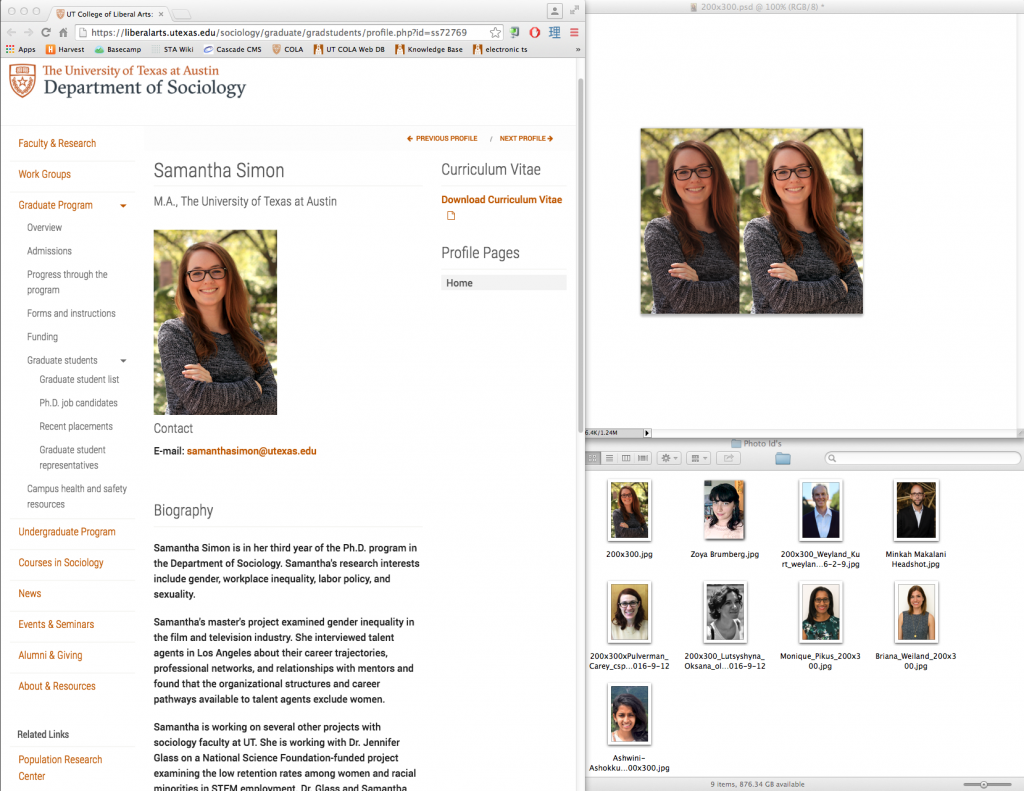
screen-shot-2016-09-09-at-3-57-58-pmscreen-shot-2016-09-09-at-3-57-37-pm

I processed more than a dozen ID Photos for CoLA graduate students and faculty. Some of the photos needed cleanups in Photoshop. Above shows the before and after of the staff profile photos.

Filed Under: 2016 - 2017, Uncategorized

PSY333D

September 9, 2016 By Valerie Lopez

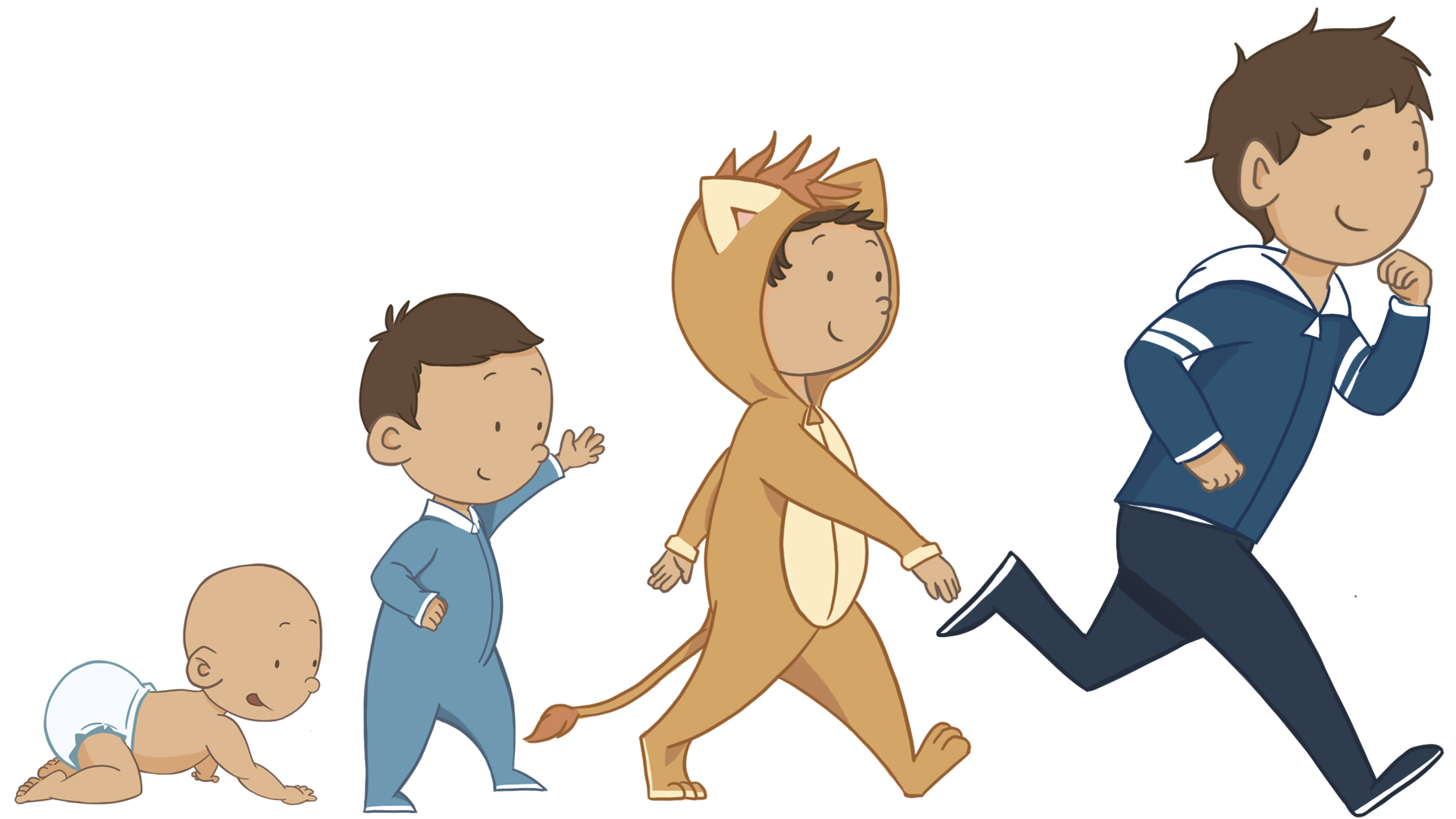
Request:Create an animation with the different stages of children ( baby, toddler, 5-year old, and 10 year old). Each child at different stages will walk behind an object and then ” grow” to the next stage. Baby crawling then moves behind bear and is a toddler. Toddler walking and then moves behind abc blocks and turns in to 5 year old. 5 year old walks and then moves behind “bush, tree, …?” and turns into 10 year old. 10 year old starts off walking and notices a little girl waiting for him and they both run off to play ground.

Professor:

Project Managers: Ashley Schenker

STA’s : Anna Xu

Character Design References: https://www.pinterest.com/characterdesigh/

First found references for drawing baby’s and toddlers. Tend to be more rounder with bigger heads.


My Character Design:

screen-shot-2016-08-25-at-2-00-36-pm


Progress So Far:

My role is to create the animations and I am collaborating with out fellow STA Anna who will be creating the props that the character moves behind.

I think you can tell by the fluidity of each of the animations that there was a point when I got used to the movement. The baby is a bit glitchy and then the walk cycle of the toddler is a bit smoother but the arms are a bit strange. By the third walk cycle of the toddler I feel like I got a hand of it and by the 10 year old I was satisfied with the animation and moved onto completing the color. Might need to change the colors a bit since it differed from the ones on my computer screen.

Filed Under: 2016 - 2017, Uncategorized

  • « Previous Page
  • 1
  • …
  • 75
  • 76
  • 77
  • 78
  • 79
  • …
  • 91
  • Next Page »

link to LAITS home page

Video STA Home

© 2026 Liberal Arts Instructional Technology Services | Production Credits